Is the AI Bubble Like 1929? 3 Warning Signs From the Crash
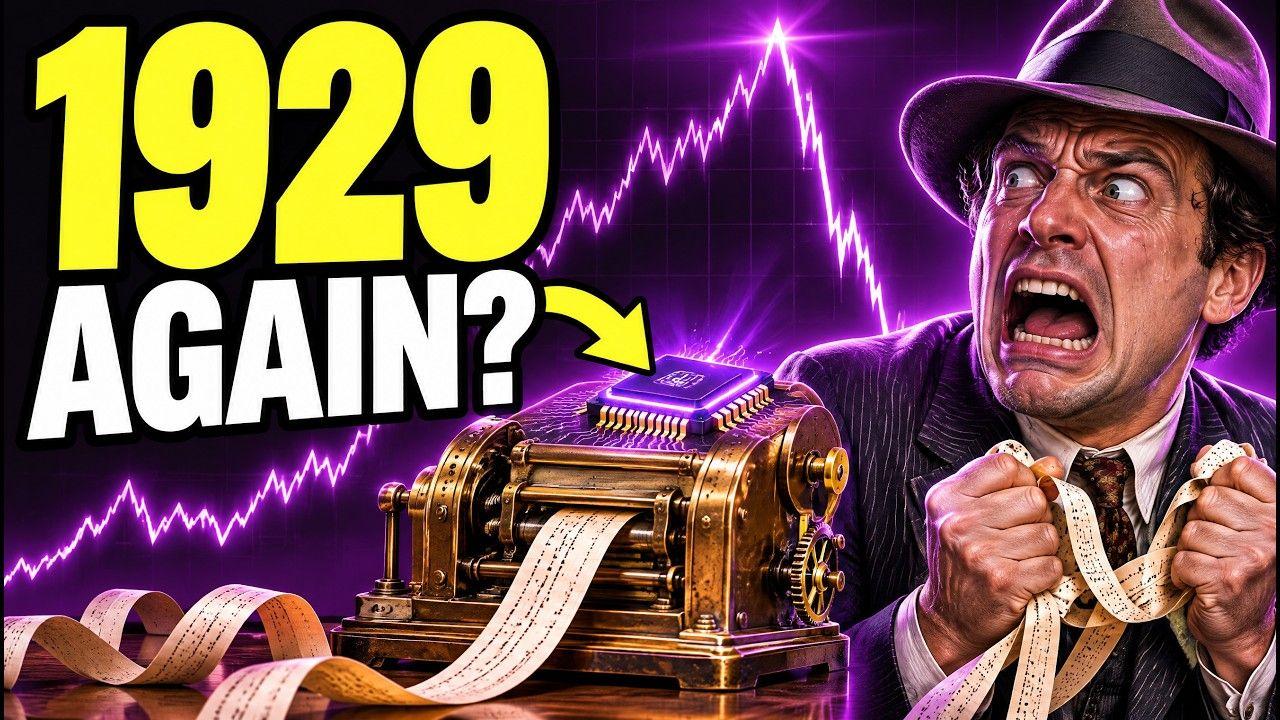
On Thursday, October 29, 2026, Alphabet stock fell 12%, wiping out about half a trillion dollars before dinner. That date was 97 years to the day after Black Tuesday, the worst day of the 1929 crash.
So is AI 1929 all over again? The best way to answer is to look at what the people who got out in 1929 were actually watching.
Watch the 9-minute version
Advertisement
The short answer
Bubbles tend to need three things at once: something real and exciting, a price that only works if new buyers keep arriving, and borrowed money speeding it up. Today, AI clearly passes the first test, the second is a question mark, and the third cannot be measured well. Before you act on any stock tip, ask: is it real and is the price right, who is left to buy, and is borrowed money doing the work?
The three gears of a stock market bubble
- Gear one, something real: In the 1920s it was radio. For the first time, a voice in New York could reach a farmhouse in Kansas instantly. The hot stock was RCA, the Radio Corporation of America. It cost $43 a share in 1926 and $568 three years later.
- Gear two, a price that needs new buyers: When a stock rises 13 times, you are no longer paying for radio. You are paying for the hope someone will buy it from you higher. That only works while your neighbour, your barber and your cab driver keep piling in.
- Gear three, borrowed money: In 1929, putting down just 10% was normal. With $100 you could buy $1,000 of stock. A 10% rise doubled your money. A 10% fall wiped it out.
1929 stock market crash timeline
- September 3, 1929: The Dow hits 381. Nobody rings a bell at the top.
- Mid-October: Economist Irving Fisher says stocks have reached what looks like a permanently high plateau.
- Black Monday: The Dow falls almost 13%.
- Black Tuesday, October 29: It falls almost 12% more. Brokers sell borrowers' shares to get their loans back, which pushes prices lower and wipes out the next borrower.
- July 1932: The Dow is at 41, down 89%. RCA is at $15.
- November 1954: The Dow finally gets back to its 1929 high, 25 years later.
Radio was real. The price was not.
What Joe Kennedy really saw
The legend says Joe Kennedy sold after a shoeshine boy gave him a stock tip. That story first shows up in print about 30 years later, told by Kennedy himself, and one biographer calls it baloney. What we know is that Kennedy started selling long before the crash and kept his fortune.
He was an insider. In 1933 he joined a stock pool to pump shares of Libbey-Owens-Ford, a glass company that people wrongly thought would make whiskey bottles as Prohibition ended. It made car windows. In 1934, Roosevelt made him the first chairman of the new Securities and Exchange Commission, the agency built to stop exactly that kind of trick.
The dot-com rerun
Seventy years later the miracle was the internet and the stock was Cisco, whose gear ran the web. On March 27, 2000, Cisco became the most valuable company on the planet. By October 2002 the Nasdaq had lost more than three quarters of its value, and Cisco did not beat its 2000 high until December 2025. The internet was real. The price was not.
Is AI a bubble? Running the test today
Gear one is spinning. AI is real. Gear two gets a question mark. Alphabet, Microsoft, Meta and Amazon are spending hundreds of billions of dollars on data centres. The video reports that Google has posted two quarters of negative free cash flow, Meta its first since 2012, and Amazon minus $42 billion over 12 months. Picture a restaurant that spends more building kitchens than it makes from customers. Fine if the customers come, a disaster if they do not. Gear three stays blank: the amount of borrowing in this market could not be verified.
And this is not 1929. On Black Monday 1929 the Dow fell almost 13%. In the 2026 sell-off the drop that Friday was just over 1%. There are limits on borrowing, a regulator and a central bank that learned from 1929, and Microsoft just made $18.6 billion of free cash flow in one quarter. Anyone who says they know this is the top is guessing.
FAQ
Is AI a bubble like the dot-com bubble? AI is real, as the internet was. The open question is whether prices are running ahead of profits. Spending is rising faster than cash flow at several big tech firms.
What caused the 1929 crash? Exciting new technology, prices that needed ever more buyers, and stock bought with up to 90% borrowed money. When prices fell, forced selling made the drop much worse.
How long did it take the stock market to recover from 1929? The Dow did not return to its 1929 high until November 1954, about 25 years later.
Did Joe Kennedy really sell because of a shoeshine boy? Probably not. The story first appeared decades later, told by Kennedy himself.
This is education, not financial advice.
Advertisement